FALMOUTH HISTORICAL SOCIETY – 125 YEARS
On March 19, 1900, the first meeting of the Falmouth Historical Society was held in the old Town Hall. R. C. Bodfish, a birthright Cape Codder, and a relative newcomer in town named Rev. H.H. Smythe, realized that Falmouth’s fascinating history was in danger of being forgotten. They gathered together a group of like-minded history lovers who were determined not to let that happen.
Historical societies were a novelty on Cape Cod (Falmouth’s was the first). Yet almost immediately, the people of the town responded to the Society with enthusiastic generosity. Whaling families named Swift, Lawrence, Jones, and Davis donated over 40 ship’s logs, along with dozens of maps and navigational charts, and precious daguerreotypes. Even before the Society had a building of its own, it had a significant collection of artifacts. Rev. Smythe, serving as the Society’s first president, oversaw the effort to conserve these objects. A safe deposit box at the Falmouth National Bank was acquired to protect a 1796 Paul Revere document, while other artifacts went on display at the public library. Society members were encouraged to write memoirs. Smythe himself undertook painstaking fieldwork in Falmouth’s cemeteries, creating a transcript of epitaphs that remains a definitive source today.
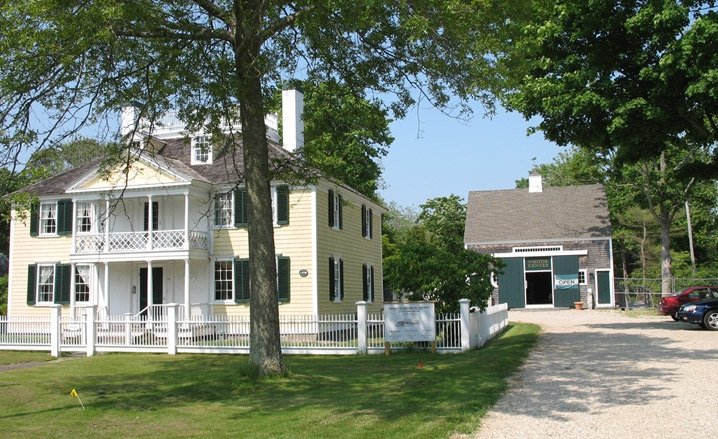
A new era began for the Society in 1932 with the acquisition of the Dr. Francis Wicks House, bequeathed by founding member Julia Swift Wood. This 1790 house gave the Society an enhanced opportunity for educational programming. Visitors could be immersed in the Federalist, whaling, and Victorian eras, by imagining the lives of generations of people who once lived in the house. The gardens surrounding the house amplify this experience, particularly the 50 x 100 foot Colonial garden. The Falmouth Garden Club has cultivated this garden, and the rest of the Society’s grounds, since 1932.
Another longstanding collaboration has seen the Society partnering with local schools to host field trips for third and fourth graders. This tradition, with a few interruptions, dates back to 1950.
In 1966, the Society purchased the 1730 Conant House, a former home to ministers, mariners, and innkeepers. Conant House is used for exhibitions, educational programs, offices, and for archives and research. A 2016 renovation upgraded its archival storage space by providing better climate control and more efficient shelving.
In 1996 the Society purchased its first computer and hired its first Executive Director, Ann Sears, continuing its growth as a professional museum. By 1997 it had an internet presence.
The early 21st century saw the Society increase its space for community programming with the construction of a Cultural Center in 2012. Lectures, workshops, movie screenings, and children’s programming take place in the Cultural Center year round—always with a focus on Falmouth history.
As the 21st century advances, the Falmouth Historical Society is still carrying out its mission to preserve local history. The Society actively seeks to collect artifacts that illustrate life in the 20th century, as well as materials that shed light on marginalized groups in all eras who have been overlooked. Staff and volunteers are digitizing the collection at a steady pace, and also creating interactive experiences both online and in person, making history accessible to ever more people.
After 125 years, the Falmouth Historical Society stands at the junction of past and future—preserving history with an open mind toward new perspectives and possibilities.