Programs
Campus Tours at the Museums
Open June 5th – October 16th, 2026
Monday 10-2pm, Tuesday 10-2pm, Friday 10-2pm, Saturday 10-4pm
We also host historical walking tours year round. Click here for the current schedule of historical walking tours.
For special events, see below.

- This event has passed.
Cape Cod & The Islands Whaling Symposium
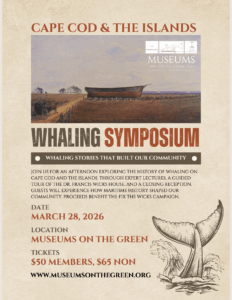
Saturday, March 28th, 1-5pm
Join us for an afternoon exploring the history of whaling on Cape Cod and the Islands. Through expert lectures, a guided tour of the Dr. Francis Wicks House, and a closing reception, guests will experience how maritime history shaped our community. Proceeds benefit the Fix the Wicks Campaign.
$50 for Museums on the Green members / $65 non-member
Sponsored by Judy Frank, great-great granddaughter of Captain Zenas Hamblin of Waquoit.
Register Here
Program:
-1pm Opening Remarks by Falmouth Historical Society Vice-President John Bissonnette, Descendant of the Falmouth Lawrence Whaling Family
-1:15 pm Falmouth’s Whaling Heritage with Joseph Mattingly and Falmouth’s Whaling Wives with Carolyn Partan
-2:45 Break
-3pm Fair Winds and Following Seas: Uncovering History & Climate Clues from our Whaling Past with Dr. Timothy D. Walker and Dr. Caroline C. Ummenhofer
-4pm Bubbly Reception in the Portrait Gallery of the Wicks House and themed tours of the Wicks House focusing on Whaling Captain Warren Nye Bourne who lived in the house 1844 to 1882.
Falmouth Whaling Wives: Back by popular demand, whaling scholar Carolyn Partan will share stories about the adventurous lives of Falmouth’s whaling wives and children.
Carolyn Partan Bio:
Carolyn retired in 1999 from working as a real estate attorney in Boston and has been an active volunteer for the Falmouth Historical Society ever since. Like many others, she has taken on multiple roles. She revived and expanded the third grade program plus participated in other school collaborations. She has worked on fundraising, including as co-chair of the 2016 renovations of Conant House. Other positions she has held include Interim Executive Director (2000-2001), Secretary of the Board (2000-2006) and most recently as President (June 2022 – January 2023). She has done extensive research on Falmouth’s whaling history, among other topics. For the new Falmouth Art Center, Carolyn was a key person in its building and fundraising. Prior to moving year-around to Falmouth, she served on the Massport Board by gubernatorial appointment. Carolyn has degrees from Wellesley College (BA) and NYU School of Law (JD).
Falmouth’s Whaling Heritage
In the early 19th century, Falmouth remained a remote farming and fishing community. But then the growing New England whaling industry began to capture the imagination of Falmouth youth who dreamed of adventure as Cape Horn sailors searching the Pacific Ocean for whales and whale oil. Falmouth was no competition for New Bedford, the “city that lit the world,” but whaling and whaling-related trades became Falmouth’s principal business. Falmouth was the home port of 13 whaling ships that made 52 whaling voyages, mainly to the Pacific, between 1820 and 1860. Six whalers were built in Falmouth, most of them at Bar Neck Wharf in Woods Hole, under the oversight of the patriarch of Falmouth whaling, Elijah Swift. With a total population of no more than 2600, Falmouth produced an astounding 65 whaling ship captains, some of whom took their wives on whaling voyages of three to five years and had children born at sea. In this presentation, you will compare the Falmouth boys’ dreams of glory and adventure with the hard, punishing realities of whaling.
Jos Mattingly Bio:
Joe Mattingly is a docent at Falmouth Museums on the Green with a special interest in the history and culture of New England and Falmouth whaling. Joe has himself recently traveled several of the whaling grounds of the Pacific and once lived for two and a half years in the Republic of the Philippines as a U. S. Air Force officer following an initial assignment at Otis AFB here on the Cape. Joe is a native son of Maryland, a long-time docent for Historic Annapolis, and a retired lawyer. He and his wife returned part-time to the Cape in 2011 and have lived here permanently since 2019. Knowing what he does, Joe still has difficulty understanding why a young man who went on a four-year whaling voyage to the Pacific in the 1800s would want to go again.
Fair Winds and Following Seas: Uncovering History & Climate Clues from our Whaling Past
Timothy D. Walker1,2 and Caroline C. Ummenhofer2
1Department of History, University of Massachusetts, Dartmouth, MA
2Department of Physical Oceanography, Woods Hole Oceanographic Institution, Woods Hole, MA
A trove of whaling ship logbooks spanning the period 1790 to 1910 exists in New England archives, such as Falmouth Historical Society, Martha’s Vineyard Museum, Nantucket Historical Association, New Bedford Whaling Museum, and Providence Public Library. Whaling records also are also key source materials for the Sailing to Freedom project, which highlights little-known stories of freedom-seeking by sea and describes the less-understood maritime side of the Underground Railroad. This new research, directed and explained by Dr. Timothy Walker, Professor of History at the University of Massachusetts Dartmouth, expands our understanding of how freedom was achieved by sea – and why the whaling industry is an important component of this emerging story.
Jointly with oceanographer Dr. Caroline Ummenhofer from Woods Hole Oceanographic Institution, the talk also highlights that whaling ship logbooks do not only hold value for historical, genealogical, economic, and ecological research, but can also be of use to climate scientists. From each logbook, researchers can gather unique historical weather data from key climate zones covering Atlantic, Pacific, and Indian Ocean whaling grounds. Further, unlike merchant or military vessels, whaling ships did not follow established sea lanes, but instead visited some of the most remote waters on earth, opening a window into past climate conditions. The logbooks contain systematic daily weather observations, such as wind strength/direction, rainfall, and cloudiness. The talk demonstrates how the historical records provide an important long-term context for changing weather patterns over the world’s oceans lacking instrumental observations during the 18th-19th centuries. It will discuss challenges and opportunities for climate research through data rescue and digitization of these under-utilized historical ship logbooks.
Bios:
Bio: Caroline Ummenhofer received a Joint Honours B.Sc. in Marine Biology and Physical Oceanography from Bangor University, UK, and a PhD in Applied Mathematics from the University of New South Wales, Australia, specializing in climate modeling. She joined Woods Hole Oceanographic Institution as faculty in 2012. Her research focuses on the ocean’s role in extreme events, such as droughts and floods, and their impact on human and natural systems. She has participated in art-science collaborations at museum exhibits about marine heatwaves and the oceanic water cycle, and provided educational resources on extreme weather for K-12 schools serving students around the world.
Bio: Dr. Timothy Walker (Hiram College, 1986; MA/Ph.D. Boston University 2001), Professor of History at the University of Massachusetts Dartmouth, is a scholar of maritime history, colonial overseas expansion, and trans-oceanic slave trading. Walker is a guest investigator of the Woods Hole Oceanographic Institution, a contributing faculty member of the Munson Institute of Maritime Studies, affiliated faculty of the “Slavery North” initiative, and Director of the National Endowment for the Humanities “Landmarks in American History” workshops series for middle- and high school teachers, titled “Sailing to Freedom: New Bedford and the Underground Railroad” (2011–2025). In 2020, Walker was appointed by the Governor of Massachusetts to serve on the Schooner Ernestina/Morrissey Advisory Board, where he is the chair of the Educational Programming Committee.