In March 1621, when Plymouth’s survival was hanging in the balance, the Wampanoag sachem (or chief), Ousamequin (Massasoit), and Plymouth’s governor, John Carver, declared their people’s friendship for each other and a commitment to mutual defense. Later that autumn, the English gathered their first successful harvest and lifted the specter of starvation. Ousamequin and 90 of his men then visited Plymouth for the “First Thanksgiving.” The treaty remained operative until King Philip’s War in 1675, when 50 years of uneasy peace between the two parties would come to an end.
400 years after that famous meal, historian David J. Silverman sheds profound new light on the events that led to the creation, and bloody dissolution, of this alliance. Focusing on the Wampanoag Indians, Silverman deepens the narrative to consider tensions that developed well before 1620 and lasted long after the devastating war-tracing the Wampanoags’ ongoing struggle for self-determination up to this very day.
This unsettling history reveals why some modern Native people hold a Day of Mourning on Thanksgiving, a holiday which celebrates a myth of colonialism and white proprietorship of the United States. This Land is Their Land shows that it is time to rethink how we, as a pluralistic nation, tell the history of Thanksgiving.
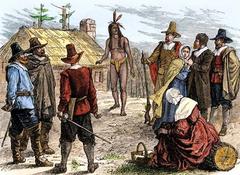 They came seeking religious freedom. They found an untamed, inhospitable and dangerous wilderness. They struggled with deprivation, disease and death. Through the grace of God and with the help of the “People of the Dawn,” they survived. As the 400th Anniversary of the landing of the Pilgrims approaches, travel back to 1620 and relive their first year: the difficult voyage over the Atlantic, the landing on Cape Cod shores, the “first encounter” with the Wampanoag Nation, the move onward to Plymouth, the first settlement, and the first harsh winter that took nearly half the colony. First-hand accounts, 19th century maps and satellite imagery reveal the places the Pilgrims explored on the Cape…and might inspire you to follow in their footsteps.